


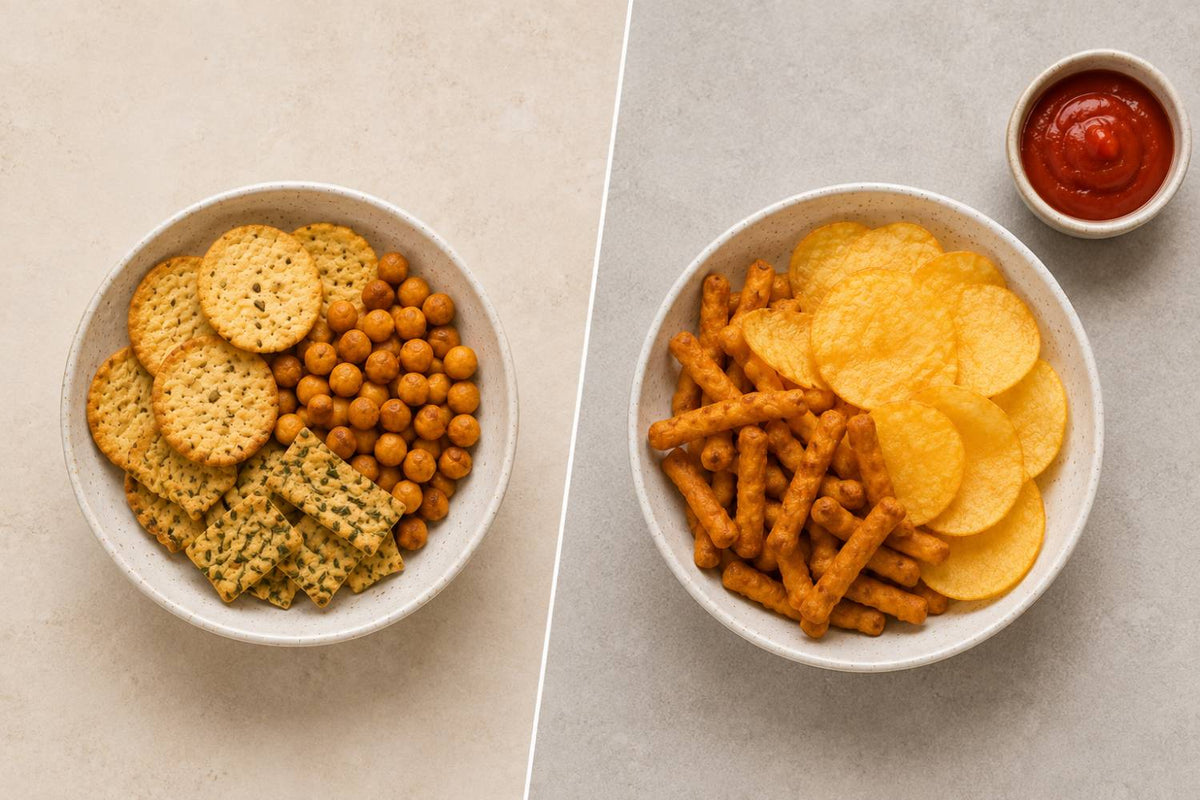
You’re hungry and it’s 5 pm. There are two packets of snacks before you. The first one is marked as crispy fried. The second one proudly bears the label of oven-baked. In all probability, you would pick the latter.
Is it true that all those packets of snacks labeled as oven-baked become healthy just because they are baked rather than fried? Is it true that baking makes the snack nutritionally better?
Baking may decrease the quantity of oil added to the snack; however, the method of cooking is not everything there is to nutritional value. Ingredients used, portions served, sodium content, type of fat and processing also play their role.
Let us take a closer look at what is altered in a snack when it is baked rather than fried.
Baked vs Fried Snacks: What Is the Difference?
Frying food is done in hot oil. As water evaporates, there is an opportunity for oil to get into the structure of the food. The quantity of oil depends on the food item, type of coating applied, temperature, time taken to fry and the type of oil used.
It has already been established that oil absorption is one of the reasons why deep-fat fried foods have the potential to be high in calories. Unlike frying, baking entails cooking food by exposing it to hot, dry air within an oven. Oil can be applied during the process of cooking, but only enough to allow for browning. In such a case, the food does not entirely come into contact with the oil.
That is the basic difference between baked vs fried snacks. Where frying directly exposes food to a large quantity of oil, baking often creates crunch using much less.
1. Fried Snacks Usually Absorb More Oil
Deep-frying of chips, samosas, and namkeens results in the removal of moisture and the addition of fat, which can quickly increase the snack’s total calories.
Most baked snacks use little fat, even though companies may use fat or shortening to enhance the taste and texture of the snack. When the same recipe is baked instead of deep-fried, the baked version will often contain less added fat. So, opting for baked snacks can be a healthier choice of snack, especially for those who love crunchiness.
2. Baked May Mean Fewer Calories - But Check the Label
While reducing oil may lead to reduction in calorie content, the term “baked” should not necessarily mean the food item is nutritionally balanced. Baked cookies made from refined flour, sugar, and lots of palm oil might still be high in calories. Serving sizes may be tricky, too.
When comparing healthy snack options, consider the following:
- Number of calories in 100 grams
- Fat and saturated fat contents
- Amount of protein and fibre
- Sodium
- Sugar
- Recommended serving size
And then ask yourself whether the serving size is a true reflection of how much you’d normally consume.
For instance, a packet may show the calories for a 20-gram serving even though the packet contains 60 grams and is usually eaten in one sitting. There is far more information on the nutrition label than what the “baked” word promises on the front.
3. The Type and Quality of Fat Matter
Not only does the conversation involve the quantity of fat in the snack food, but also the nature and state of the fat itself. Frying oil may oxidise and degrade with repeated reheating, depending on the type of oil, temperatures and frequency of use. Studies have shown that there may be an increase in the markers of oxidation with repeated frying.
It may be particularly applicable in the case of commercially fried foods where the quality of oil and its reuse is unknown. But this does not mean that the baked goods will be exempt from using the undesirable fats either. There may be some shortening or high saturated fat content in some cookies and crackers.
The World Health Organization advises limiting the intake of saturated fats and trans fats that occur in industrial food processing. So, no matter if you buy the fried or baked snacks, check the ingredients to see the type of oil used.
4. Ingredients Matter More Than Minor Nutrient Changes
The heating process may affect the nutritional content; however, there is not any general rule suggesting that baking retains all the nutrients whereas frying destroys all.
As per a study , nutrient retention varies according to the original ingredient, cooking temperature, cooking time and method used.
As for prepared snacks, the initial food quality is sometimes more important than the slight variation in nutrient retention. Baked snack containing millets, pulses, nuts or seeds would be higher in fiber, proteins or healthy fats than those containing predominantly refined flour or starch.
In other words, the oven will not convert poor nutritious food into a nutritious one. Therefore, for truly healthy baked snacks, the composition of ingredients is as important as the method of preparation.
5. Both Baking and Frying Can Form Acrylamide
Acrylamide can occur naturally in some starch-containing foods when they are cooked at high temperatures like frying, roasting and baking.
According to the FDA , acrylamide occurs naturally when there is a reaction between certain sugars found naturally in food and an amino acid called asparagine. The substance is commonly found in potato and grain-containing products. (U.S. Food and Drug Administration)
This is not to say that all crunchy snacks or crackers are dangerous. All it means is that time, temperature and the degree of browning of the food matter.
It should be noted from the FDA that baking time and temperature can be altered to reduce the amount of acrylamide in cereal containing foods. (U.S. Food and Drug Administration)
When cooking, remember to cook until your food is light golden in color instead of deep brown. Don’t burn your bread, potatoes and homemade crackers.
6. Baked Does Not Always Mean Low-Sodium
"Salts" represent another aspect that may mislead you due to the misleading "baked" term.
The manufacturers sometimes use excessive amounts of salt or other seasonings and additives for adding more taste to low-fat snacks. Consequently, while a baked snack may have a lower amount of fats than a fried one, its sodium content is usually extremely high.
Be aware of both the sodium content per serving and per 100 g, as well as of the number of servings per package.
The best healthy baked snacks will combine taste and moderate seasoning instead of high salt content.
7. Look Beyond the Cooking Claim
Think of two snacks hypothetically.
Snack A is baked, but the ingredients include refined flour, starch, sugar, palm oil and flavorings.
Snack B consists of millets, lentils, nuts and seeds but with very little oil while cooking.
There is no way of concluding which one is healthy without looking at its entire ingredients and nutritional profile. Therefore, baked versus fried is not all that matters when it comes to snacks.
The right snack would ideally have:
- Fibre, protein and/or good fats
- Ingredients recognizable
- Moderate salt content
- Not too much sugar
- Little oil
At The Cinnamon Kitchen, we have our Crispy Millet Pita that is an oven-baked snack made from millet flour, nuts and seeds. Our aim is not only to call it a baked snack. It is about the ingredients behind the crunch as well.
Are Baked Snacks Healthy?
They definitely can be, especially when they have lesser amounts of oil and are made using ingredients thoughtfully. However, “baked” alone doesn’t define whether a snack is nutritious.
For those looking for snacks for diabetic patients , it is especially important to check the sugar, carbohydrate, fibre and overall ingredient profile.
Here are some questions to ask before purchasing one:
- What is the first ingredient?
- How much fat and salt does it have?
- Does it offer fiber or protein?
- What is the actual serving size?
- Are the ingredients clearly listed?
When the answers look good, then baked snacks can easily be incorporated into a balanced diet.
How to Choose Healthy Baked Snacks
Choose snacks that are prepared using natural ingredients like millets, oats, pulses, nuts, seeds, or fruits.If you prefer gluten-free options, Gluten Free Snacks made with suitable grains, nuts and seeds can also be considered. Alternatively, a snack high in carbohydrates may be eaten along with some sources of protein or healthy fats. For instance, eat baked millet crackers along with hummus, fruits with peanut butter or pita chips with beans.
The snack can be divided into small portions and served in a bowl rather than being consumed directly from a bigger pack. This will make it easier for you to monitor how much you have eaten.
Above all, the healthy snack must also be tasty since a snack that tastes good is more likely to be your choice of food.
Explore TCK’s Baked, Not Fried Snacks
For us at The Cinnamon Kitchen, everyday snacking can be crunchy, satisfying and healthy too, as our products are made with thoughtful ingredients without deep frying. You can explore more of our baked treats and snack options on our bakery website.
Our snack products are made using gluten-free flour, millets, nuts, and seeds, which don’t use maida and are designed for consumers seeking healthy snacks with really good taste.
Some of our baked favourites include:
1. Crispy Millet Pita
Using our very own gluten-free flour blend and a mix of nuts and seeds, the Crispy Millet Pita is baked to perfection, turning out beautifully golden brown. It is delicious to have it with hummus or guacamole, or simply on its own when you crave some crunch.
2. Methi Millet Crackers
These healthy Methi Millet Crackers are made using millets and methi. They are not fried but only baked and are free from any maida or preservatives. They are a good alternative to our traditional fried matri.
3. Cardamom & Almond Biscotti
Twice-baked for that perfect crunchy texture, these biscuits are made using millet flour, almond flour, and 45% almonds. Our Cardamom & Almond Biscotti goes well with chai or coffee and does not contain maida.
4. Almond Flour & Cacao Cookie
Containing almond flour, almond butter, and vegan dark chocolate, this tasty cookie is rich in protein content with each cookie containing 7.8 grams of protein. These protein cookies are gluten-free, dairy-free, and contain no refined sugar.
Our baked, not fried, snacks are about much more than how we prepare them. Be it millet biscuits, savory pitas, rich nuts cookies, or twice baked biscotti, all these products come with carefully chosen ingredients, making snacking an experience worth enjoying.
The Final Verdict
When it comes to comparing baked vs fried snacks, baking is usually favorable since it can produce crunchiness with a minimal amount of oil. Therefore, the product may have fewer calories and fat, especially in the case of deep frying.
However, the way of preparation is not everything. There may be snacks prepared by baking that are high in refined flour, salt, sugar or saturated fat. The nutritional value of snacks is determined by their composition, type of oil, processing and serving size.
So, are baked snacks healthy? Certainly, especially if they consist of fiber-filled grains, legumes, nuts and seeds, with moderate salt and low added fat content.
The wisest decision is to choose not only "baked," but thoughtfully baked snacks with healthier ingredients.
Frequently Asked Questions
1. Are air-fried snacks the same as baked snacks?
Both methods cook food using circulating hot air. Air fryers usually cook faster because they have a smaller chamber and more concentrated airflow. Both can use considerably less oil than deep-frying, depending on the recipe.
2. Can children eat baked snacks regularly?
Baked snacks can be incorporated in their healthy diet regime. It is important to choose age appropriate snacks having lesser sodium content and no additional sugar. Also, snacks with millets, legumes, nuts, and seeds can be included in their daily routine.
3. Do baked chips help with weight loss?
Weight loss is dependent on various factors and baked chips can be a part of any one’s weight loss journey. They have less fat content compared to fried chips, but the amount of calories and size of the serving still come into play. Snacks with high protein and fibre content are typically more satisfying than those made out of refined carbohydrates.
4. Is roasting healthier than baking?
Both roasting and baking are considered to be dry-heat cooking techniques. What matters most is the composition of the ingredients used, the amount of oil used, temperature and cooking time and not whether it is called a roasted or baked product.
5. How should baked snacks be stored?
Baked snacks should be stored in an airtight packaging away from heat, light and moisture sources. Properly sealing the package will prevent the snack from getting soft due to humidity.
Popular Searches
Natural Almond Butter | Jim Jam Biscuit | Walnut Brownie | Gluten Free Snacks | Sugar Free Cookies | Sugar Free Cake |
Popular Blogs
Types Of Millets | Gluten Free Foods | Muesli Vs Granola | Pre Workout Snacks | Diabetic Dessert Recipes | Is Granola Healthy | Almond Butter Vs Peanut Butter | Sattvic Foods
