


Quick Overview
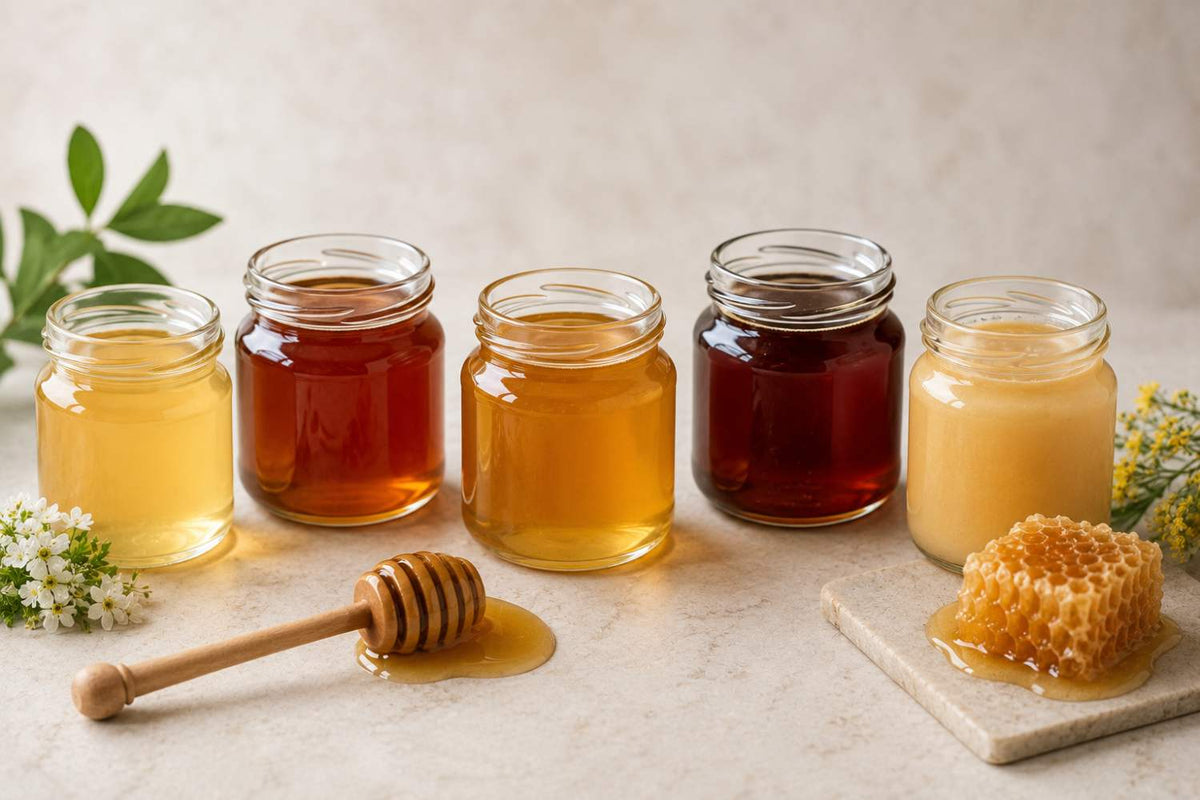
Different types of honey vary by floral source, region, flavour, texture and processing. Acacia and Clover are mild, while Manuka and Eucalyptus have stronger flavours. Wildflower and multifloral honey can change with the season. Whichever variety you choose, remember that honey remains a source of sugar and should be used in moderation.
Introduction
Most of us reach for honey when a cup of tea needs sweetness or breakfast feels a little plain. Yet the honey used on toast may taste nothing like the darker jar brought home from a forest region. One can be light and floral. Another may be thick, woody or slightly herbal.
The difference is not only in the name on the label. Flowers, location, season and processing all influence what finally reaches the jar. Knowing the different types of honey makes it easier to choose one for your taste and intended use.
In This Article
What Makes Honeys Different From Each Other?
7 Types of Honey and Their Benefits
Raw Honey vs Processed Honey: What’s the Difference?
How to Choose the Right Honey for Your Needs
How to Use Honey in Everyday Food
Honey and Health: Things to Keep in Mind
What Makes Honeys Different From Each Other?
Honey begins with the flowers visited by bees. Monofloral honey comes mainly from one plant species. Multifloral honey contains nectar collected from several flowers. The multifloral honey meaning is simple: the nectar comes from several types of flowers rather than one main floral source.
The foraging region also matters. Local plants, climate and rainfall can change the colour, aroma and flavour. Texture may range from runny to thick. Some varieties crystallise sooner because of their natural sugar composition.
Processing creates further differences. Raw honey is minimally handled, while other varieties may be heated or finely filtered to produce a clearer, more consistent product.
7 Types of Honey and Their Benefits
From mild Acacia to earthy Manuka, each variety brings its own flavour, texture and natural compounds to the jar.
1. Acacia Honey
Acacia honey is pale, clear and delicately sweet. It remains liquid longer than many varieties because it crystallises slowly.
Its gentle flavour suits tea, yoghurt, toast and light dressings. It mainly provides carbohydrates, along with small amounts of naturally occurring plant compounds. Its mild taste does not make it sugar-free or automatically suitable for people with diabetes.
2. Manuka Honey
Manuka honey is produced from the mānuka plant of New Zealand. It has a thick texture and strong earthy flavor.
MGO measures its methylglyoxal levels, while UMF measures more general indicators of potency, authenticity, purity and freshness. These ratings allow you to compare food-grade honey. Medical-grade honey is sterilized and tested separately for approved wound care products. Do not use Edible Manuka honey on wounds.
3. Wildflower Honey
Wildflower honey is produced from nectar collected across several flowers rather than one particular plant. It is therefore a type of multifloral honey.
Its colour can range from pale gold to dark amber. The flavour changes according to the region and harvest season. Different batches may also contain varying amounts of antioxidant plant compounds.
4. Clover Honey
Clover honey has a light amber colour and mild sweetness. Its balanced taste works well in tea, on toast and over oatmeal. It can also be added to baking recipes and salad dressings.
Like other varieties, it contains small amounts of natural plant compounds but remains primarily a source of sugar.
5. Eucalyptus Honey
Eucalyptus honey has a pronounced aroma and a herbal or woody taste. Its exact flavour depends on the eucalyptus species visited by the bees.
It contains antioxidant compounds and may show antimicrobial activity. The amount and strength can vary, so it should not be treated as medicine.
6. Lavender Honey
Lavender honey comes from bees that forage around lavender flowers. It has a floral aroma and a light, delicate taste.
Its subtle sweetness pairs well with yoghurt, fruit, toast and mild cheeses. It can also be added to herbal drinks.
7. Indian Berry Honey and Forest Honey
Indian Berry Honey is collected from the nectar of berry blossoms and usually has a rich, rounded flavour. Forest or multifloral honey may contain nectar from several plants growing within the same foraging region.
These Indian varieties can differ by landscape, rainfall and harvest period. Their colour and taste may therefore change between batches.
Raw Honey vs Processed Honey: What’s the Difference?
The main difference between raw and processed honey is how it is handled after it is extracted. Neither option is automatically better for all.
|
Feature |
Raw Honey |
Processed or Filtered Honey |
|
Processing |
Usually strained with little or no heating |
May be heated or passed through finer filters |
|
Appearance |
Can look cloudy or contain tiny particles |
Usually clearer and more uniform |
|
Natural contents |
May retain pollen and other naturally occurring compounds |
Fine filtration may remove some pollen and particles |
|
Texture |
Can vary from one batch to another |
Often has a smoother, more consistent texture |
|
Crystallisation |
May form crystals over time |
Can also crystallise, depending on the floral source |
|
Best suited for |
Those who prefer minimal processing |
Those who prefer a clear appearance and uniform texture |
Raw honey is not automatically healthier. In a normal serving, the nutritional difference may be small. Filtering can improve clarity and texture without making the product inferior.
Crystallisation is a natural process and does not necessarily mean that honey has gone bad. Gently warming the sealed jar in water can make it runny again.
Potential Benefits of Honey
Honey offers more than sweetness, although its benefits depend on the variety and amount consumed.
- Honey contains antioxidant plant compounds that help protect cells from oxidative stress. The amount depends on the floral source and the region.
- Its natural carbohydrates provide a readily available source of energy.
- A small amount may soothe a mild cough in adults and children over one year old.
- Certain varieties have shown antimicrobial activity, although food-grade honey should not be treated as medicine.
- Honey provides small amounts of minerals and other plant compounds.
How to Choose the Right Honey for Your Needs
There is no single answer to which honey is best for health. The right choice depends on the flavour you enjoy, how you plan to use it and your dietary needs.
|
If you prefer |
Consider |
|
Mild sweetness for tea, oats or toast |
Acacia or Clover |
|
A stronger aroma and distinctive flavour |
Manuka or Eucalyptus |
|
Soft floral notes for fruit or yoghurt |
Lavender |
|
Flavour that changes by region and season |
Wildflower or Multifloral |
|
Honey that reflects Indian plants and landscapes |
Indian Berry or Forest Honey |
|
Minimal processing and natural variation |
Raw honey |
|
A clear texture for everyday cooking |
Filtered honey |
If you are wondering which honey is good for health, look beyond the variety. Read the ingredient label, choose a reliable source and watch the quantity. People following a vegan diet generally leave honey out.
How to Use Honey in Everyday Food
Honey is a natural sweetener that works in both sweet and savoury dishes. Stir a little into tea, coffee or plant-based milk. Drizzle it over plain yoghurt, oats or fruit. For breakfast, try a small amount over yoghurt topped with Berry & Banana Millet Granola.
Honey also works well on toast with Almond Butter. In savoury recipes, it can balance marinades and salad dressings. It also adds sweetness and moisture to selected bakes.
For teatime, serve a honey-sweetened warm drink with sugar free cookies or a slice of sugar free cake. A light floral tea also pairs well with Sugar-Free Cacao & Berry Rocks.

Honey and Health: Things to Keep in Mind
- Honey contains sugar and calories. Replacing refined sugar with honey does not make portion size irrelevant.
- Never give honey to a child under 12 months because of the risk of infant botulism.
- People with diabetes need to count it within their total carbohydrate intake. It is not sugar-free.
- Anyone allergic to pollen or bee-related products should speak with a doctor before trying a new variety.
- Honey may ease a mild cough, but it cannot replace medical care for symptoms that persist or worsen.
Conclusion
The flowers, region and harvest season give each honey its own flavour, colour and texture. Choose a variety based on the taste you enjoy and how you plan to use it. A small amount is usually enough in breakfast bowls, warm drinks and selected recipes.
For more everyday food choices made with thoughtfully selected ingredients, explore our bakery website, The Cinnamon Kitchen’s Gluten Free Snacks.
Frequently Asked Questions
-
What are the different types of honey?
Common types are Acacia, Manuka, Wildflower, Clover, Eucalyptus, Lavender, Indian Berry and Forest Honey.
-
Which type of honey is best for everyday use?
Acacia and Clover are convenient everyday options because their mild flavour works well with drinks, toast and breakfast bowls.
-
What is the difference between raw and regular honey?
Raw honey is minimally processed. Regular honey may be heated or passed through finer filters for a clearer appearance and more consistent texture.
-
Is darker honey healthier than lighter honey?
Darker honey may contain different levels of plant compounds, but colour alone does not determine its overall health value.
-
Can honey be eaten every day?
A small amount can fit into many diets. Its sugar, carbohydrate and calorie content should still be considered.
Popular Searches
Jim Jam Biscuit | Walnut Brownie | Snacks For Diabetic Patients
Popular Blogs
Types Of Millets | Gluten Free Foods | Muesli Vs Granola | Pre Workout Snacks | Diabetic Dessert Recipes | Is Granola Healthy | Almond Butter Vs Peanut Butter | Sattvic Foods
