


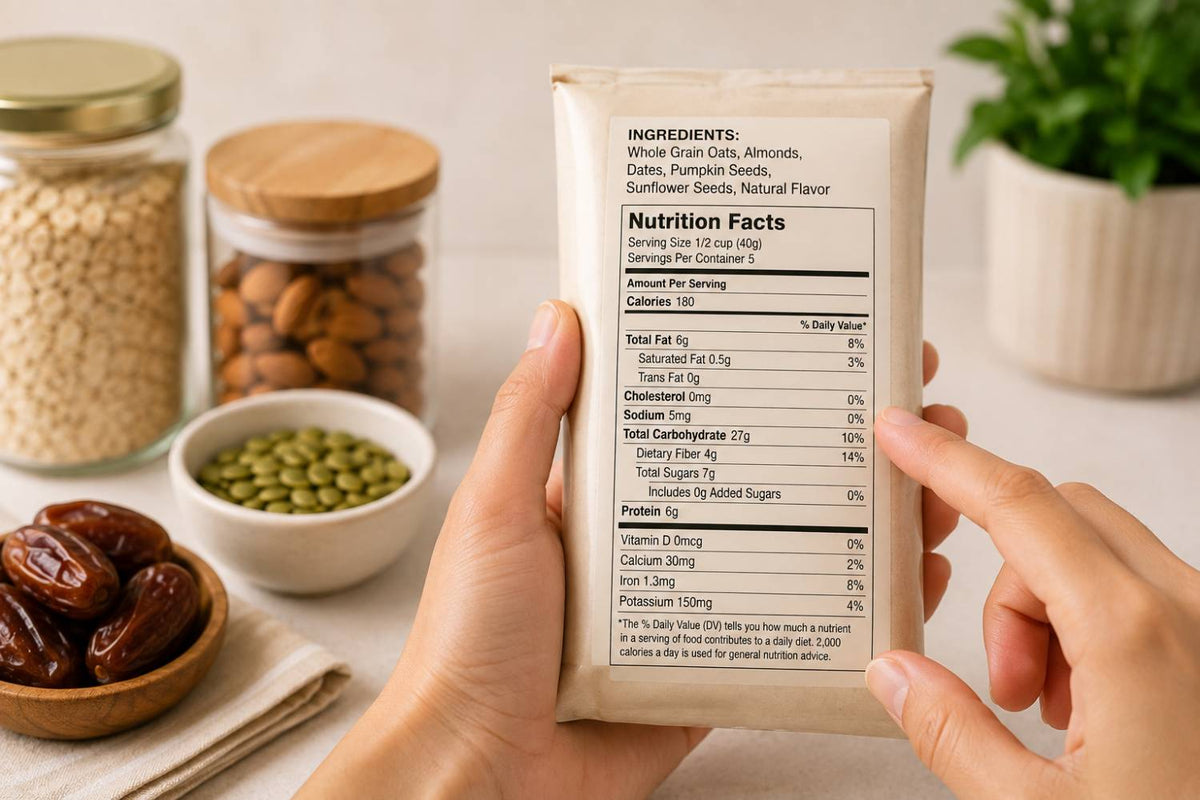
You pick up a box of cookies that says “multigrain,” “high protein” and “made with natural ingredients.” Prima facie it appears to be a sensible choice. Then you turn the packet around and find a list of ingredients that appears to really complicated.
In that scenarios, should you put the packet down? Try searching for all those terms online? Or should you rely on the seemingly harmless claims written on the cover?
Here it is important to understand that learning how to read food ingredient labels does not require a nutrition degree. All it takes is understanding where to focus, what needs to be compared and the details to concentrate on. Also, as per a study done on supermarket shoppers, it has been found that 90% of participants said they read food labels, 81% mainly checked the manufacturing or expiry date and only a few accepted to pay close attention to the ingredients list. So, while we may be turning the packet around to read, we may not always be looking at the details that matter most.
To help you out, here are the steps needed to go past the cover and understand your labels better.
First, Turn the Packet Around
Package front serves to grab your attention.
Such terms as “natural,” “multigrain,” “baked,” “protein,” and “no refined sugar” can be helpful, but usually, they do not reveal the whole picture.
Even though a cracker is baked, it can include refined flour, lots of oils, and high amounts of sodium. Even if a product is multigrain, it can consist of several grains in small amounts, while the major ingredient would be refined flour.
It does not mean that the product is bad; it just means that you have to confirm the label by looking at the ingredients list and nutrition facts.
In other words,
the front presents the product, and the back tells about it.
Start With the Ingredient List
For the purpose of learning how to read food ingredientlabels, one needs to start with the ingredients rather than focusing on the calorie content.
FSSAI has laid down regulations in relation to the labelling of packaged foods. Under such regulations, the ingredients found in packaged foods are listed from top to bottom depending on their percentage at the point of production. In other words, the first item listed comes in the greatest proportion followed by the second and so forth.
It is therefore crucial to consider what is found at the beginning of the list.
Let’s suppose that there are two crackers whose ingredient lists are given below.
Cracker A: Refined wheat flour, palm oil, starch, sugar, seeds and salt.
Cracker B: Millet flour, lentil flour, nuts, seeds, coconut oil and salt.
Although both of them can be sold as crunchy snacks, it is clear that their ingredient basis is quite different.
Focus on the First Three to Five Ingredients
There is no need to analyze all ingredients at once. Just start by focusing on the first three or five, as they comprise the majority of the product.
Questions to ask include:
- Is the first ingredient whole grain, millet, pulse, nuts, seeds, or fruit?
- Is refined flour the main ingredient?
- Is sugar among the first ingredients?
- Are oils among the major ingredients?
- Is the advertised major ingredient of the product among the first ones?
FSSAI requirements also state the proportion of any ingredient must be stated in case when the ingredient is emphasized through words, pictures, or graphics on the package and knowing its amount is needed to avoid misleading consumers.
Therefore, if you see almonds, cacao, fruits, or millets highlighted on the front side, check out their percentage on the backside.
Learn to Recognise Different Forms of Sugar
Sugar is not always called “sugar”.
It may come under names such as:
- Glucose syrup
- Invert syrup
- Malt syrup
- Dextrose
- Fructose
- Cane sugar
- Brown rice syrup
- Jaggery
- Honey
- Date syrup
- Coconut sugar
Each of these sugars has different nutritional value, and sssome may contain some other compounds too.Thus, all these ingredients have to be taken into consideration while estimating the amount of sugar consumed in total.
The food item may contain more than one type of sugar in smaller amounts. Since each of them appears on the list as a separate ingredient, neither of them is the first one despite their total contribution being high enough.
Examine the ingredient label as well as the “total sugars” and “added sugars” sections in the nutrition label. The labeling laws in India mandate declaration of carbohydrates, total sugars, and added sugars on the nutrition label of appropriate food packages.
It should also be noted that “no refined sugar” does not necessarily mean “sugar free.” Foods containing dates, honey, jaggery, or coconut sugar do not contain any refined sugar but still contain some form of sugar.
Do Not Judge a Product Only by Ingredient-List Length
While you might have heard that a product with fewer ingredients is healthier, it’s only partly true. If one item has oats, almonds, seeds, cacao, cranberries, spices and natural flavors, then it will definitely have more ingredients than an ordinary biscuit made from refined flour. And yet, it doesn’t mean that a biscuit with fewer ingredients is healthier.
An unknown substance in a product isn’t necessarily harmful too, as ingredients like tocopherols are often types of vitamin E, and pectin is frequently added to give structure to fruit products.
It would be better to focus on:
- Main ingredients of the product;
- Purpose of the rest of the ingredients;
- Several colors, flavors or sugar substitutes;
- Compatibility of ingredients with the advertised product type.
Note: The aim is not to fear every technical name. It is to understand the overall composition of the product.
Read the Nutrition Label Alongside the Ingredients
The list of ingredients tells what the product contains. The nutritional information tells the amount of energy and certain nutrients in the product.
In terms of nutritional labeling, FSSAI mandates that any applicable labels include information on nutrition for 100 grams/100 ml/single serving pack size, along with information on certain nutrients, including energy, protein, carbohydrates, sugar, fat, and sodium.
While reviewing the nutrition labels of products, you need to pay close attention to:
1. Protein and Fibre
Protein and fibre help increase the satiety value of snacks; however, one figure is not the right way to evaluate an entire product.
Do you know the source of protein? Does the product contain almonds, peanuts, seeds, lentils, or other sources of proteins? Is the small amount of isolated protein added to the product to justify its front-of-pack label?
2. Added Sugar
Instead of trying to evaluate if a certain number is inherently bad or good, compare the amount of added sugar found in similar products.
For instance, you can compare two packages of granola that belong to the same product category per 100 grams. Comparing one brand at 30 grams with another at 45 grams will be misleading.
3. Sodium
Savoury foods may have more sodium content than expected; for example, those that are marked baked, low-fat or gluten-free. So, evaluate the sodium content per serving and take into account the portion of the package you usually eat. A relatively small serving size can mislead you if you normally eat several servings at once.
4. Total and Saturated Fat
Fat is not inherently unhealthy. The natural sources of fats in the diet include nuts, seeds, and nut butters, which may also serve as nutritious food items.
It is important where the fat comes from. So, it is sadvisable to see the ingredients for identifying the sources of fat, nuts and seeds or shortening/oil.
Check the Serving Size Carefully
One way to misunderstand a nutrition label is by assuming that the figures provided on the label are based on the whole package.
The numbers may be for one cookie, 25 grams or one-third of a package and not all the food contained in the package.
Consumers' perceptions of and behaviors towards products may be affected by serving sizes as reported in a study examining scientific literature about serving size information.
Before comparing calories, sugar or sodium content, first have a look at:
- What is the serving size?
- How many servings are there in the package?
- How much do you really eat?
When comparing two different products, always go to the per 100 grams column.
Look for Allergens and Cross-Contamination Information
In the case of a person who suffers from a food allergy or intolerance or a medical dietary requirement, the knowledge of the allergen would be crucial.
FSSAI requires specified allergens such as gluten containing cereals, milk, eggs, fish, peanuts, tree nuts, soy and a certain amount of sulphites which need to be separately stated as per FSSAI. There can also be a presence of allergen in the form of ‘may contain’ statements in cases where cross contamination is suspected.
Do not jump to conclusions about the product being safe just because the recipe seems to lack the allergen.
For instance, the food item may be prepared in a facility which deals with wheat. People suffering from celiac disease or other severe allergies need to check both the ingredients as well as manufacturing/allergen statements.
All our products at our bakery website, The Cinnamon Kitchen are prepared in a dedicated facility which is 100% gluten free. We have also used ingredients like millets, nuts, seeds, gluten free oats and natural sweeteners in our various products and mentioned what is in each pack.
Be Careful With Health Halos
Some words might exaggerate the nutritional content of a food item.
- Multigrain
It means that more than one grain has been used in the preparation of the product. It does not indicate that these grains have been used as whole grains or if the refined flour is not there in it.
- Baked
Baking can involve less use of oil than frying. Nevertheless, you have to see the quantities of fat, sodium and refined flour used.
- Natural
It does not tell you the amount of sugar, sodium, fiber and proteins available in the product.
- High Protein
This does not involve the source of protein. It only tells about the amount of proteins present in the product and per serving size.
- No Added Sugar
It usually means that no additional sugar has been added to the product. However, there might be natural sugars present in the food from fruits or milk.
The 30-Second Label Check
When you grab another bag of snacks next time, follow this simple process:
First 10 seconds: Look at the first five ingredients.
Second 10 seconds: Look for the serving size, protein, fibre, added sugar, saturated fat and sodium.
Last 10 seconds: Look for potential allergens, sugars, and check if the front-of-package claims match the back of package facts.
There is no need to find the nutritionally ideal snack. All you have to select is the one that works best for you.
Conclusion
Rather than memorising nutritional guidelines that are overly complicated, learning how to read food labels means asking yourself a set of simple questions.
What does this product consist of mostly? Where is the source of its sugar? Is the portion size reasonable? Do the nutrition labels confirm the claims on the package? Are the food ingredients consistent with your expectations from the snack?
When you learn how to ask yourself these questions, you will find going to the grocery store much simpler. It is never about assigning a good/bad status to foods you see there. It is about looking through misleading packaging and realizing what you are actually buying.
Frequently Asked Questions
1. What does an INS number mean on the ingredient label?
INS means International Numbering System and is used to describe the ingredients of food products which are classified as additives. The INS number does not always mean that the product is dangerous because it just describes an additive or its function, for example, a preservative, stabilizer or coloring.
2. Should calories be the first thing I check on a food label?
Not necessarily, as calories may be helpful in understanding the nutritional value, but they cannot give you information about the quality of the ingredients. Start by looking at the serving size and the ingredient list and then at the calories together with protein, fiber, sugar, fat and sodium.
3. How should I compare two packets of different sizes?
You need to look at the nutrition values based on 100 grams, not per serving.
4. Does “vegan” automatically mean a product is healthy?
Not necessarily. Vegan products simply imply that there are no animal-based products in them; they do not show whether the product has low or high amounts of sugar, salt, white flour, or saturated fats. Check the entire list of the contents and nutritional values.
5. What is the difference between an expiry date and a best-before date?
The best before date refers to the quality of the product in terms of taste and quality when the product is stored properly. The expiry date or use by date is mostly about the duration for which it is safe to consume the product. Follow the storage guidelines on the packet.
Popular Searches
Gluten Free Bread | Granola | Nut Butter | PCOS Friendly Snacks | Keto Snacks India | Vegan Dark Chocolate | Natural Almond Butter | Jim Jam Biscuit | Walnut Brownie | Gluten Free Snacks | Sugar Free Cookies | Sugar Free Cake |
Popular Blogs
Types Of Millets | Gluten Free Foods | Muesli Vs Granola | Pre Workout Snacks | Diabetic Dessert Recipes | Is Granola Healthy | Almond Butter Vs Peanut Butter | Sattvic Foods
