


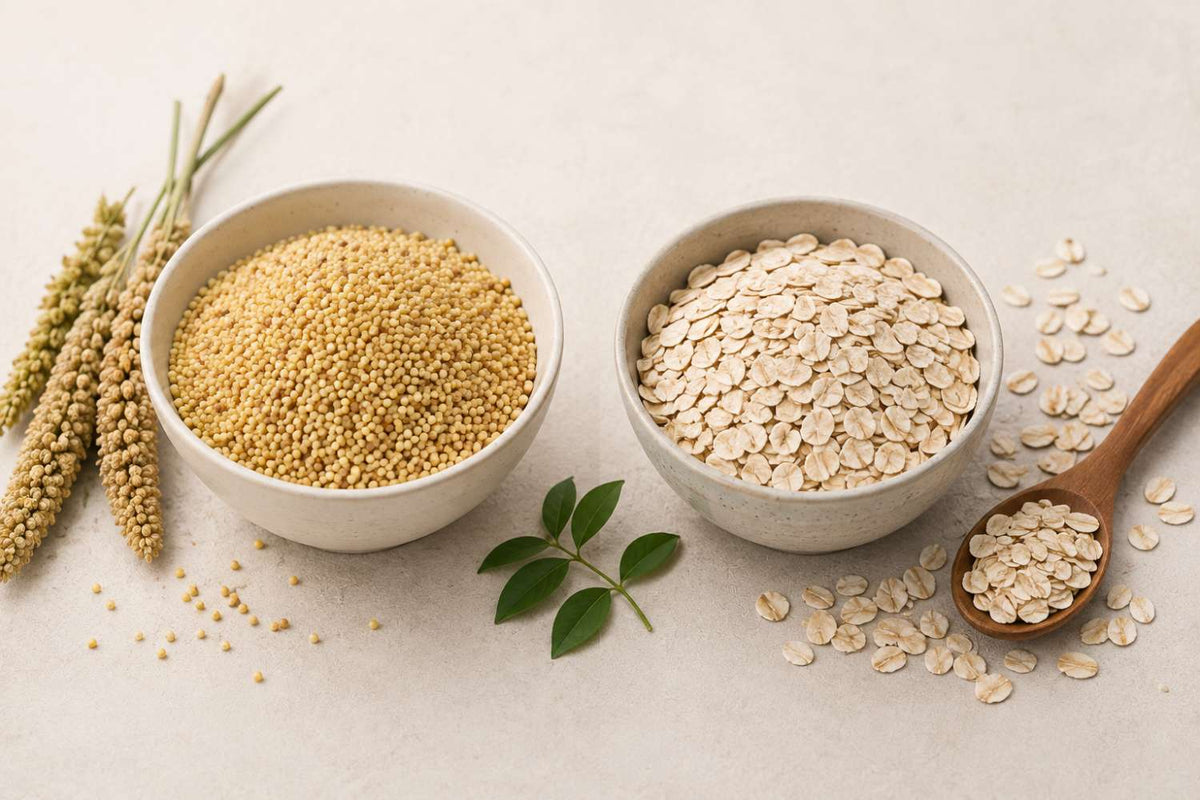
Walk into any supermarket today, and you will be amazed at how different the market is nowadays. Among familiar products such as rice and wheat, there is an increased number of items made of oats, millets, and other whole grains. Whether it is cereal, crackers, cookies or baked snacks, whole grains are gaining popularity among those who want to eat healthily.
Nevertheless, when choosing between the wide variety of available options, one can ask:
Which one should you prefer, millets or oats?
It turns out that both are healthy whole grains that belong to the same category of foods. These whole grains are rich in fibre and nutrients, which makes them healthier than most refined grains. However, they are not the same because each grain has its advantages and can be used differently. Thus, it makes more sense to ask:
Which grain is better for you?
Here you will find all the information regarding millets vs oats when comparing nutrition, fibre, protein, gluten, versatility, and everyday use of these products.
What Are Millets?
Millets are a category of small seeds of ancient cereals grown for millennia, especially in India, Africa and parts of Asia. Well before the advent of refined cereals, millets played a key role in the diet as hardy, nutritious crops with inherent adaptability to different climatic conditions.
Some of the common types are as follows:
- Jowar (Sorghum)
- Bajra (Pearl Millet)
- Ragi (Finger Millet)
- Foxtail Millet
- Little Millet
- Barnyard Millet
- Kodo Millet
They are gluten-free by nature and are widely consumed in porridges, rotis, upma, khichdi, bakery items and snacks.
In today's world, they are witnessing a revival owing to increasing demand for wholesome cereals.
What Are Oats?
Oats are whole grains mainly cultivated in colder parts of the world. They are known as a healthy breakfast food and are consumed in different types like rolled oats, steel cut oats, and instant oats.
Uses of oats include:
- Porridge
- Overnight oats
- Smoothies
- Granola
- Cookies
- Muffins
- Energy bars
There are a number of reasons why oats have become popular among many people, but one is because of their flexibility. Oats can be used in both sweet and salty dishes and are a good source of whole grains in your meals.
While oats are naturally gluten-free, there could be contamination from wheat, barley, or rye during processing. This means those with coeliac disease or gluten sensitivity need to check for gluten-free oats.
Millets Vs Oats: Nutritional Comparison
While both millet and oats are high in complex carbohydrates, vitamins, and minerals, it is always better to look at them from an angle other than competition, to be able to appreciate their distinct qualities.
Millets
Millets come packed with:
- Fibre
- Plant proteins
- Magnesium
- Phosphorus
- Iron (depends on variety)
- B vitamins
- Carbohydrates that are naturally gluten-free
Each one is different, and each brings something different to the table.
Oats
- Oats have been known to provide:
- Beta-glucan (soluble fibre)
- Plant proteins
- Magnesium
- Manganese
- Phosphorus
- Iron
- B vitamins
Oats have been particularly popular for their beta-glucans.
The Biggest Difference: Variety Vs Specialisation
Diversity may be the primary thing that sets millets apart from oats.
The term "oats" means one particular grain only.
On the contrary, "millets" are an array of grains with their own unique taste, texture, and nutritional value.
For instance,
- Ragi is famous for its natural abundance of calcium.
- Bajra contains iron and magnesium.
- Jowar is full of fiber and antioxidants.
- Foxtail Millet is widely used in nutritious breakfast and savory foods.
So diverse they are that you will not be tired of eating different types of millets throughout the week.
Which Grain Is Better For Breakfast?
Both millets and oats are perfect foods to have for breakfast.
For those who want something quick like porridge, overnight oats or smoothies bowls, oats are the way to go.
On the other hand, millets give us the great flexibility of enjoying porridge, millet upma, dosa, pancakes, granola, baked goods or even breakfast cookies.
So the best breakfast is not all about grains but also having proteins, fats and fruits for energy.
Which Grain Is Higher In Fibre?
However, millets and oats are high in fibre content compared to polished rice and refined flour. Dietary fibre is very useful in improving digestion and creating satiety.
Oats have beta-glucan fibre which has gained a lot of attention in research concerning its effectiveness in maintaining healthy levels of cholesterol within a well-balanced diet.
In contrast to oats, millets contain insoluble as well as soluble fibre. Soluble fibre adds fullness to the body and insoluble fibre adds bulk to the body and helps in digestion.
Instead of selecting one grain over another, one can include a mix of both these grains in their weekly diet.
Which Grain Offers More Protein?
For those interested in incorporating plant protein into their diets, both millets and oats can help in fulfilling that objective.
While oats are known for their comparatively high content of protein in relation to other cereals eaten regularly, millets too offer plant-based protein along with minerals and fibre. Though the percentage of protein in millets differs based on which millet one is eating, they go well together with pulses, dairy or nuts, making a balanced meal.
It needs to be noted here that neither is a good source of complete protein on their own. Mixing either with yogurt, nut spreads, milk, lentils and seeds helps make a balanced meal.
Which Is Better For Digestion?
Both millets and oats have the ability to promote digestive wellness, although the two differ in some ways.
The water-soluble fiber found in oats combines with water and turns into a gelatinous substance while digesting. This is what makes oats gentle on digestion and thus a great breakfast option.
Millets consist of fiber in general and are naturally free from gluten, which means that this food product can be used by anyone who wants to enrich their menu.
Remember that when incorporating either of the foods to your daily routine, you should not do this too fast and drink a lot of water.
Which Grain Is Better If You're Avoiding Gluten?
Here lies the most significant difference between the two grains.
Millets are natural gluten-free grains, thus, providing a perfect solution for anyone on a gluten-free diet. Millets have been used as staple grains by traditional Indians long before gluten-free dieting was even heard of.
Oats are also gluten-free by nature, but often processed alongside other grains such as wheat, barley, and rye, which increases the risk of gluten contamination during the process of processing.
In case you are coeliac or suffer from medical gluten intolerance, always select certified gluten-free oats or naturally gluten-free grains such as millets after consulting your health care provider about your dietary requirements.
Which Grain Fits A Busy Lifestyle Better?
In terms of convenience, both cereals have something to offer.
Oats can be easily prepared in no time. From overnight oats, porridge, and smoothies to making it a convenient choice for mornings on-the-go.
On the other hand, millets need a bit of preparation in case you choose to cook them yourself; however, after cooking, they are very versatile. Millets can be enjoyed in breakfasts, salads, rotis, upma, khichdi, baked goods, and even desserts.
Modern times have provided us with many ready-to-eat millets products as well, allowing us to incorporate them in our daily diet effortlessly.
So... Should You Choose Millets Or Oats?
This question will be answered based on your lifestyle and dietary preferences.
Select millets if you:
- Wish to add a greater variety of whole grains to your diet.
- Adhere to a gluten-free diet.
- Like the challenge of using indigenous Indian grains.
- Fancy naturally varied texture and flavors.
Select oats if you:
- Desire fast-breakfast choices.
- Are fond of overnight oats and porridge recipes.
- Enjoy baking with oats.
However, the positive aspect of this matter is that you need not make a choice between these two grains!
Incorporating both oats and millets into your weekly diet allows you to benefit from their unique health benefits.
How The Cinnamon Kitchen Makes Millets A Part Of Everyday Eating
At our bakery website, The Cinnamon Kitchen, we feel that eating healthy is not only fun but easy too. That's the reason we have created a wide variety of gluten free snacks that ensure you have the easiest way to add millets to your daily diet. Whether it is our walnut brownie,Berry & Banana Millet Granola, Methi Millet Crackers or every product is specifically created to offer the benefits of millets through familiar and daily consumed food items.
The use of nuts, seeds, oats, and dark chocolate in our products makes them taste amazing and nutritious. They have been prepared in a completely gluten-free facility, with plant-based options and absolutely no preservatives or artificial ingredients.
Conclusion
In terms of comparison between millets vs oats, there is no such thing as a "better" grain, as both have unique nutritional benefits that make each grain valuable in its own right and can help in making your diet well-balanced. On one hand, oats are easy-to-cook cereals known for their high content of soluble fibers; on the other, millets boast amazing diversity, are free from gluten, and have been an integral part of traditional Indian cuisine for ages. Rather than opting for only one of them, try to eat both grains in your meals throughout the week.
Frequently Asked Questions
1. Can I Eat Millets And Oats Together?
Yes, definitely. The combination of millets and oats is very good and may be added to the same diet. For instance, you can eat oats during breakfast and then have millets in your lunch or dinner. You can even add oats and millets in your food preparation such as granola, porridge, or baked products.
2. Which Millet Is Best For Everyday Eating?
It should not be said that there exists a single best millet, as all types have some unique features in terms of nutrition. Ragi millet is known for its content of calcium; bajra provides iron and magnesium, whereas jowar contains enough fibre and antioxidants. So it may be a good idea to alternate millets throughout a week in order to benefit from their features and add variety to one's menu.
3. Can Children Eat Millets Instead Of Oats?
Yes, children can consume millets instead of oats in accordance with their age-specific requirements. Like oats, millets contain fibre and other nutrients which may be included in children's diets in age-specific products like porridges or even pancakes and baked snacks.
4. Where Can I Buy Good Quality Millet-Based Snacks?
If you are looking for high-quality snacks based on millets, try to select products with ingredients that are easy to understand and without lots of artificial preservatives and additives. In The Cinnamon Kitchen you can find a wide selection of gluten free snacks products containing millets. These products include Berry & Banana Millet Granola,Walnut Brownie, Methi Millet Crackers and many others.
Popular Searches
Natural Almond Butter | Jim Jam Biscuit | Sugar Free Cookies | Sugar Free Cake
Popular Blogs
Types Of Millets | Gluten Free Foods | Muesli Vs Granola | Pre Workout Snacks | Diabetic Dessert Recipes | Is Granola Healthy | Almond Butter Vs Peanut Butter | Sattvic Foods
