


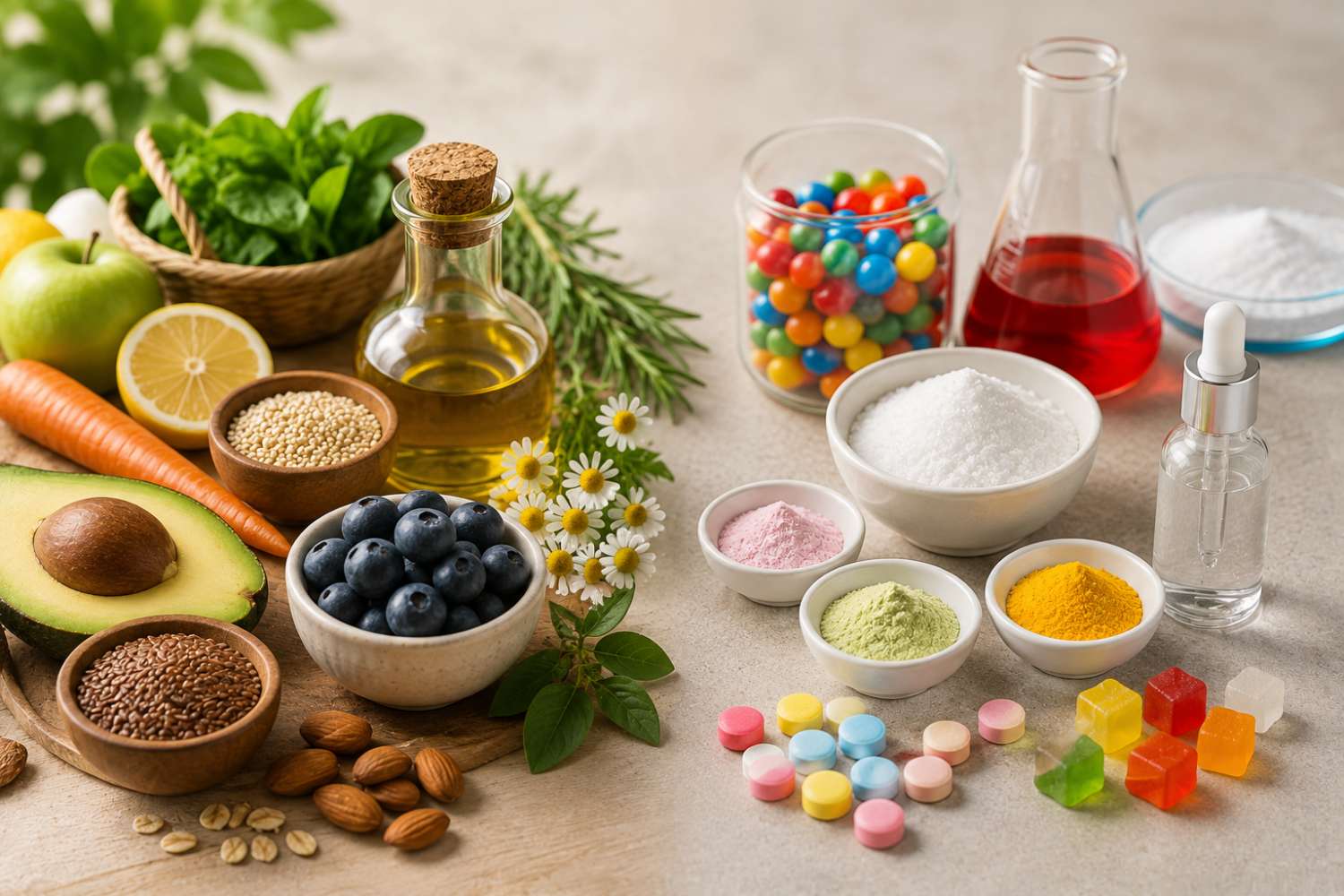
Checking ingredient labels has become a common practice among consumers due to growing awareness regarding what people eat. Consumers are becoming increasingly concerned about finding foods that have a clean label, minimal processing, and clear ingredient labels. When comparing natural ingredients vs artificial ingredients, it is not so easy to decide which of them to prefer because natural ingredients are not necessarily healthier, and artificial ones are not always bad. Knowledge about where, how, and why those ingredients are added to food products will allow you to make wise decisions about food intake.
What Are Natural Ingredients?
Natural ingredients are obtained from plants, animals, or natural minerals and have undergone minimal processing before making it to the consumer’s hands. Examples of such include fruits, vegetables, whole grains, nuts, seeds, herbs, and spices. This is because they are kept in their natural state; therefore, they end up having natural nutrients that include fiber, vitamins, minerals, and antioxidants among others. Even though natural does not necessarily imply healthiness, these ingredients are frequently used in whole-food items.
Natural ingredients usually are:
- Derived from nature, such as from plants, animals, or even natural minerals.
- These products are only minimally processed so that they keep their nutrient content.
- These products are naturally loaded with various nutrients such as fiber, vitamins, minerals, antioxidants, and phytochemicals.
- Found in whole food sources, like fruits, vegetables, grains, nuts, seeds, herbs, and spices.
What Are Artificial Ingredients?
The term “artificial ingredients” refers to the use of ingredients that are made by chemicals and are common in foods that are processed. Such ingredients are added to foods that are processed so as to improve the taste, appearance, texture, shelf-life, and consistency of the foods. Examples of artificial ingredients include artificial colors, artificial flavors, artificial preservatives, and artificial sweeteners. Artificial ingredients are approved and considered safe by the food safety authorities but do not add any nutrition value.
Use of artificial ingredients in processed food is meant to:
- Extend shelf life
- Improve flavor and color
- Maintain texture and consistency
- Decrease manufacturing cost
- Ensure consistency across production lots
Natural Ingredients vs Artificial: Key Differences
When it comes to the discussion about natural ingredients versus artificial, people are always considering where those ingredients are obtained from and why they are added. The ingredients that are regarded as natural come from plants, animals, or naturally occurring minerals. Natural products can be less processed compared to artificial products. Also, natural products contain higher amounts of vitamins, minerals, and other nutrients as well. On the other hand, artificial ingredients are usually manufactured using some chemical processes and their purpose is making food taste and look better.
|
FEATURE |
NATURAL INGREDIENTS |
ARTIFICIAL INGREDIENTS |
|
Source |
Derived from plants, animals, or minerals. |
Created or modified in laboratories. |
|
Processing |
Simply processed or moderately processed. |
Synthesized chemically. |
|
Nutritional Value |
Often have naturally-occurring nutrients. |
Mostly functional in nature. |
|
Shelf Life |
Mostly short. |
Usually longer. |
|
Flavor |
Naturally occurring. |
Designed to enhance flavour. |
|
Color |
From natural sources |
Artificial colorants |
|
Common Examples |
Oats, almonds, cocoa, honey. |
Artificial colors, flavors, preservatives. |
|
Consumer Preference |
Popular among clean-label shoppers. |
Preferable for convenience and consistency. |
Are Artificial Ingredients Always Bad?
Often times, artificial ingredients are not properly understood. Food additives undergo rigorous tests and are allowed for use only if deemed safe by food safety organizations. However, some ultra-processed foods have lots of artificial ingredients, together with sugars, salts, and unhealthy fats. This is why it makes more sense to examine a food’s nutritional content rather than just looking at an ingredient.
Remember these things:
- Approval does not mean nutrients-an ingredient could be approved but lack nutritional value.
- The amount and the frequency matter, there is a difference between eating something once in a while and eating it on a regular basis.
- Your entire diet is more important than an individual ingredient.
- Read labels instead of going by marketing slogans such as natural or clean.
How to Read Food Labels Like a Pro
Reading labels can be useful for you because it allows you to form your opinion about the product without being swayed by marketing claims. Rather than focusing solely on "natural" and "healthy," you should pay attention to the ingredient list and the nutrition facts table. In the process of ingredient comparison, you will need to think about the origin of the ingredients, their purpose, and place in the context of the product's nutrition content. Moreover, not all food additives are harmful; some of them perform practical functions.
When checking the labels, keep these in mind:
- Always check the list of ingredients before claims on the front side of the package.
- Listed by amount used, ingredients with the most content will be first.
- Shorter ingredient lists are not necessarily better; look for ingredients that are identifiable.
- Added sugars may come in different forms: glucose syrup, fructose, maltose, or cane sugar.
- Don't trust labels that say "natural" or "clean" without checking out the ingredients list.
Why Ingredient Quality Matters at The Cinnamon Kitchen
The Cinnamon Kitchen’s bakery website showcases products made with carefully chosen ingredients that provide great taste along with great nutritional value. There is no use of extra artificial preservatives in any product; only natural real food ingredients that give flavor to them are used. All products, including Almond Flour & Cacao Cookies Almond & Spice Ginger Cookies Orange & Cacao Millet Cake Oat Fig & Almond Granola Sugar-Free Cacao Hazelnut Butter and Methi Millet Crackers are prepared using carefully selected natural ingredients that give a clean label to their products.
Why The Cinnamon Kitchen?
- Thoughtfully chosen ingredients
- Natural without artificial preservatives
- Not fried but baked
- Ideal snacks for everyday consumption
- Balanced taste and nutrition
Consuming snacks made from simple and quality ingredients is a more satisfying experience. Look for such products with easily recognizable ingredients.
Conclusion
While the debate between natural ingredients versus artificial might not be about always taking sides, it's about making well-informed choices. Although there may be certain instances where artificial ingredients work just fine, it would be beneficial to consume food items that use natural ingredients in the production process. Knowing the ingredients list and nutrition details can help you have better clarity regarding how to make good food choices.
FAQs
1. Are natural and artificial ingredients different in taste?
It may not be true, as taste is determined by the recipe and ingredients rather than being natural or artificial.
2. What does a clean label mean?
Clean-label food products have simple and understandable ingredients without additional artificial substances.
3. How can food be kept fresh without artificial preservatives?
It can be done with the help of natural preservation techniques, correct packaging, refrigeration, and using such natural components as salt.
4. Are natural ingredients allergy-inducing?
It is true because of such natural ingredients as nuts, dairy, soy, and wheat.
Popular Searches
Natural Almond Butter | Jim Jam Biscuit | Walnut Brownie | Gluten Free Snacks | Sugar Free Cookies | Sugar Free Cake |
Popular Blogs
Types Of Millets | Gluten Free Foods | Muesli Vs Granola | Pre Workout Snacks | Diabetic Dessert Recipes | Is Granola Healthy | Almond Butter Vs Peanut Butter | Sattvic Foods
